Humans first. This is where I think out loud about AI, work, and careers: the frameworks I use, essays, and field notes. Start with the framework below, and check back as I add more.
Read the story behind the framework on LinkedIn
The Human Surface × Consequence Map
A framework for deciding where AI belongs
Emem Adjah · 2026
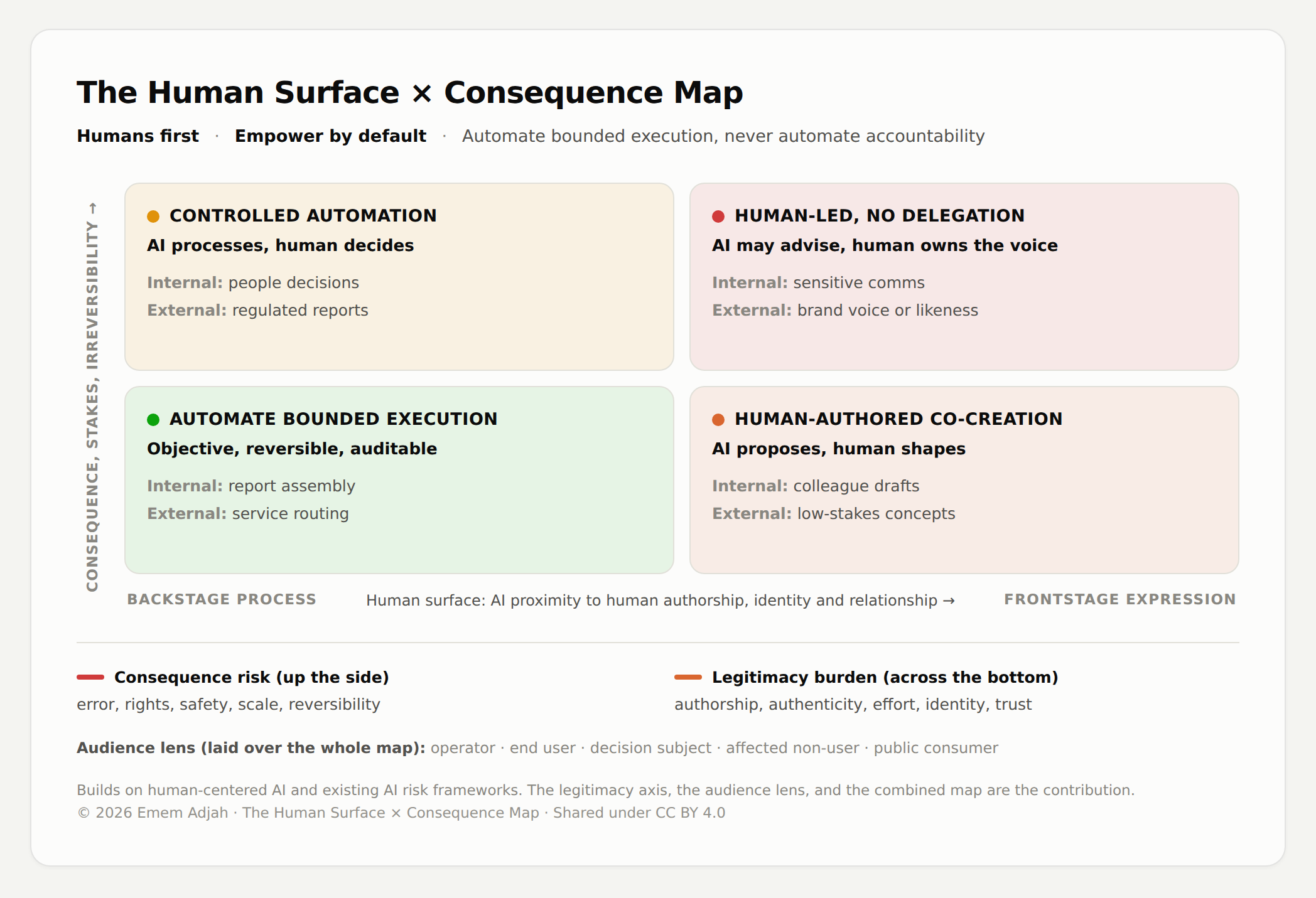
Most AI evaluation asks one question: can this cause a bad outcome? That is necessary but incomplete. AI carries two separate risks. Consequence risk is whether the output can be wrong in ways that matter: accuracy, rights, safety, scale, reversibility. Legitimacy burden is whether AI’s involvement changes what the work means to the people receiving it: authorship, authenticity, effort, identity, trust. The two can move in opposite directions.
The map has two axes. Human surface runs across the bottom, from backstage process to frontstage human representation. Consequence runs up the side, from reversible to irreversible. Internal versus external is a lens over the whole map, not a fifth axis. The four zones are shown in the diagram below.
The four zones. Automate bounded execution (backstage, low-stakes): objective, reversible, auditable; automate freely and QA the errors. Controlled automation (backstage, high-stakes): AI processes, a qualified human independently checks and decides. Human-authored co-creation (frontstage, low-stakes): AI proposes and drafts, the human supplies intent and final expression. Human-led, no delegation (frontstage, high-stakes): AI may advise, but it cannot substitute for accountable judgment, personal voice, or lived experience.
The principle. Humans first. Empower by default. Automate bounded execution, but never automate accountability.
The decision. Ask two questions of any use. First, what happens if it is confidently wrong? That is consequence. Second, who sees it, and will the audience read it as deferring? That is legitimacy.
Cite as: Adjah, E. (2026). The Human Surface × Consequence Map: A framework for deciding where AI belongs. Zenodo. https://doi.org/10.5281/zenodo.21968502
© 2026 Emem Adjah. Licensed under CC BY 4.0. Reuse and adapt with attribution.
This framework builds on and credits human-centered AI, AI risk governance (NIST, OECD, the EU AI Act), and the research on AI legitimacy and acceptability. The combined map, the audience lens, and the two-ledger view are the author’s contribution.